
At the DuSable Black History Museum this past spring, Josh Nkhata, AB’25, performed a series of original poems as part of a project called the Community Synthesizer. He began by typing out compositions written for the synthesizer and then invited audience members to type freely to produce their own work. After collecting field recordings of words and phrases from friends, family, and community members in Chicago and Minneapolis, he had built an electronic instrument to play the archive of sounds like music.
A poet and musician, Nkhata completed this capstone project as part of the Media Arts and Design (MADD) program, which offers an undergraduate major and minor. He compiled the sound recordings and connected them to keyboard strokes using Max/MSP, a visual programming language, so that each letter or word played a selection of corresponding audio files. Far from an experienced programmer, he credits his coding competence to his MADD professors, who bolstered his skills with the digital dexterity needed for a project like his.
“The MADD program feels to me to be really engaged with entering your world,” Nkhata says. Through MADD, he explains, he learned to use technology to reinvent his poetic and musical practice, rather than conforming his work to an existing technological framework.
The program, built from a set of courses first offered in the Department of Cinema and Media Studies, allows students to learn to use technology to build projects that blur traditional boundaries of genre and form, exploring and analyzing experimental and interactive media, such as video games, with an academic lens.
“Conducting a close analysis of a video game has parallels to analyzing a poem in an English course, though it depends on a grammar and structure that is medium-specific to games,” says Patrick Jagoda, William Rainey Harper Professor in Cinema and Media Studies and English Language and Literature and program director of MADD, who has authored several books on new media and has his own art practice. “Taking a game apart, through analysis and iterative design, suggests how to push toward original frameworks or experimental game projects.”
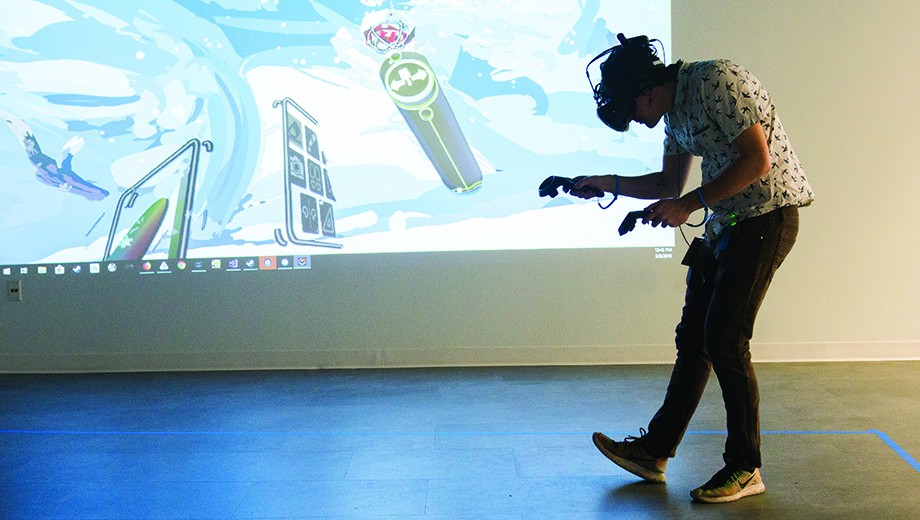
“At a place like UChicago, where everyone’s an expert at writing papers, conveying a thought through virtual reality is a skill. You don’t nail it on your first time,” says Jon Satrom, an assistant instructional professor who directs the MADD capstone program. “Our classes are spaces to experiment with different ways to land your message or share what you want to share with the world.”
The classes—with eye-catching names such as Conscious Media Practices in the Age of Brain Rot and AI + Video: Glitches, Promises & Slop—are a huge draw for the program, Satrom says. Students can pursue one of five clusters—Creative Computing, Digital Sound and Music, Expanded Cinema, Games, and Media Performance—or design their own program of study.
Students come to the program from all fields and backgrounds. Amber Auh, AB’25, drew on her experience in a neuroscience lab to build Synapse, a virtual reality installation that used real-time electroencephalogram data from its participants to project their brainwaves on a screen.
“Before I started MADD, I didn’t really know that any of this was possible,” she says. “I always knew that I’m a creative person, but I’m also pretty analytical and technical, and I think I always struggled to find what major would be best for me.”
Satrom says this overlap of the analytical, the creative, and the technical is built into the structure of the MADD program, encouraging double majors and minors for students in other academic spaces. MADD students learn to be “nimble makers,” Satrom says—creative, curious minds with the technological dexterity to solve problems and articulate themselves in dynamic and inventive ways.
“Theory gives them the critical mind and ways of analyzing the media around them, history gives them the context, and then design, or practice, teaches them to get their hands in there,” explains Riss Lawrence, AM’19, the program administrator for MADD.
Lawrence credits the program’s rapid growth to its broad appeal for students—including those without a technological background, like Nkhata, or students who have computer skills but are seeking an outlet for untapped creativity. In 2020, its first year as a major, the program had one graduating College student; this spring, Nkhata was one of 74 MADD fourth-years in the Class of 2025.
These students are not just making things, Lawrence says. “It’s also about the iterative process of trying to make something.” Aptly, she compares the program to a game: “Video games are a place of safe failure, because if you fail and you die, you can just restart and keep going. And I feel that way about MADD.”
This creative dexterity makes MADD graduates uniquely resilient in an ever-changing job market. Alumni have built careers in media-related fields such as advertising or game development or have pursued advanced degrees in media analysis, intellectual property law, and business administration for creative industries. Like Satrom and Jagoda, most MADD professors are teaching artists, and their professional networks help students seek out their ideal path.
Nkhata is now a teaching artist too: After graduation, he started teaching in the Ryan Learning Center at the Art Institute of Chicago, a position that encourages him to continue writing poetry and making music. He says the MADD program helped him to build a home for his distinct, interconnected interests and to reimagine what poetry could be.